Bengaluru has a rich cultural and built heritage dating back from the Western Ganga civilization (860 A.D.) to the Vijaynagara dynasty (1343 A.D.) to Hyder Ali-Tippu Sultan period (1753 A.D.) and later the during British period (1806 A.D.). It is noteworthy that the settlement of Bengaluru has been in existence for almost four and half centuries. Bengaluru also has a unique landform, as it is located at the ridge that separates the two river basins of the Arkavathi and S.Pinakini rivers. The city since historical times has a well-established system of cascading lakes and tanks developed over centuries. The natural heritage of lakes, heritage buildings/sites, and cultural ethos of the city exhibited through its festivals and cuisine stands testimony to its glorious past.
Conserving this ancient heritage (natural, built and cultural) is imperative as it serves as identity to the city and its origin. Yet, heritage and culture of the city needs to be more than a record of the past that creates urban identities for not only the past and present but also for the future.It is noteworthy that Bengaluru, till date, lacked the formal inventory of its heritage and cultural assets and therefore the RMP 2031 has placed heritage protection and conservation within the overall process of urban development and in course of its preparation.
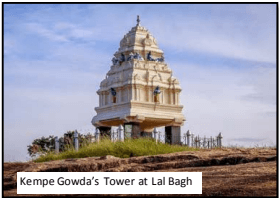
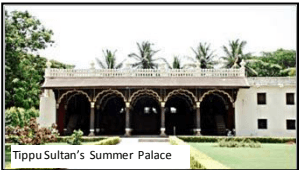
The city has seen unprecedented growth demographically and spatially since the past two decades, evolving the city into a vibrant cosmopolitan. Under this context it is additionally important to protect its Built-Cultural Heritage. The heritage narrative of Bengaluru has mostly revolved around the four Kempe Gowda’s watch towers, Tippu Sultan’s Palace precinct, the traditional markets, British era buildings of MG road, Cleveland town / Richards town, Vidhana Soudha and High Court administrative amongst many other buildings, which evoke a sense of pride and ownership among all Kannadigas and residents of Bengaluru.
14.1Need for addressing Heritage Conservation in BMA
It is essential that the heritage in Bengaluru is safeguarded, conserved and maintained in to order to mitigate and cope with impacts of rapid and fast paced urbanisation. The narrative around Heritage conservation has usually focused at improvements to build form of Heritage Site. It is important to understand that the heritage and cultural preservation/ conservation of heritage precincts do have positive impact on economy, social aspects and environment of the city, though these impacts are long term in nature. Heritage and cultural conservation may lead to boost tourism and helps in educating ourselves about our rich cultural history. Heritage conservation and designation increases property values, both of the restored building and surrounding properties. Thus Heritage preservation & conservation should be an integral part of urban development. However, it is important to note that the objective of the assignment is to prepare the Revised Master Plan 2031 and therefore the assessment of Heritage & Cultural Heritage has been done to evolve guidelines for heritage conservation in line with the provisions of Karnataka Town & Country Planning Act, 1961 (KTCP Act, 1961).
BANGALOE AUTHORITY ★
To achieve this, first most it calls for a detailed identification of all types of heritage and listing of the heritage sites/buildings, identification of the heritage listing to heritage zones by specific classifying criteria. This is followed consequently by framing of regulations and guidelines for contextual interventions (inclusive of but not limited to, conservation, restoration related activities) and at the same time regulating the development activities around these heritage sites. Finally, an institutional and enforcement mechanism that will aid in implementation of the various heritage related aspects.
These heritage related aspects needs be addressed and complemented by a comprehensive Heritage Master Plan that requires to be prepared for the entire Bangalore Metropolitan Area (BMA), the purpose of which will be to ensure heritage resources are identified, graded, protected, conserved and the heritage regulations and proposals implemented through an appropriate institutional mechanism. The master plan therefore proposes recommended that the Heritage Master Plan for Bengaluru shall be prepared.
14.2Identification and Listing of Heritage Sites
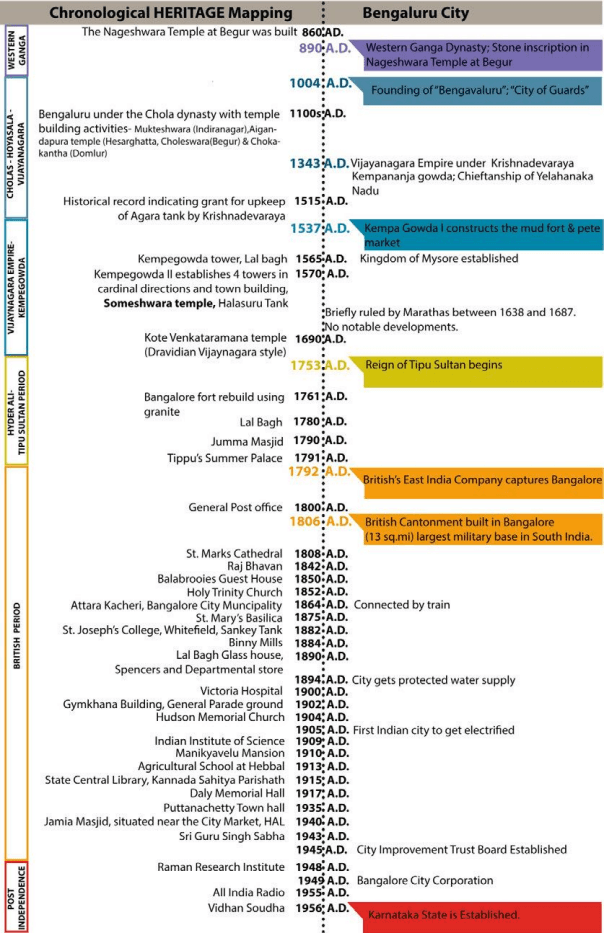
It is important to understand Bengaluru’s chronology of historical events in order to appreciate the heritage of the city. It also helps in deriving the appropriate approach to assessment of heritage and cultural aspects. Figure 14-1 presents the Chronology of history and evolution of the heritage of Bengaluru City.
14.2.1 Brief Historical Context of Bengaluru
Initial Settlement of Bengaluru: The earliest reference to Bengaluru as a settlement has reference in the 8th century (890 AD) Pancha Linga Nageshwara Temple complex that was established by the Ganga dynasty where it locates the 1100 years old stone inscription that refers to a ‘Bengaluru War’.
Bengaluru under Chola and Vijayanagara period: The city took shape as a fortified settlement under Kempegowda of the Vijaynagara state when he
established the mud fort in year 1537. The region relied heavily on lakes & tanks which were constructed right across this territory as the principal source of water for agricultural and domestic needs. It is likely that Kempegowda’s rule coincided with the development of a new urban form: a fortified settlement linked to a network of temples and tanks, later attracting many merchants and artisans who took up residence there26. This network of tanks supported mixed farming and market gardening activities. The well-known markets in the Petta where the Tharagupete–market for grains, the Balepete – for Bangles and musical instruments, the Chikkapete and the Nagarthpete for textile trade, the Ballapurpete and Ganigarapete market where oil is extracted by people of the Ganiga community, the Tigalarapete–flower market of gardeners, the Cubbonpete – textile manufacture by
26 Janaki Nair in her book title Bangalore’s Twentieth Century: The promise of a Metropolis(Oxford University Press 2005)
people of the Devanga community. Kempegowda established 4 towers (at present day Lal Bagh, Gavi puram, Ulsoor lake and Mekeri Circle) to ascertain the extent of the city and the high grounds with the city. Figure 14-1 presents the historical time lines along with the heritage mapping of Bengaluru.
17th Century: saw the influence of itinerant Sufis who redrew the sacred space of the city with dargahs and shrines. Mysore was the then capital of Hyder Ali’s kingdom and later on his son Tippu Sultan took over. Mysore was Tippu Sultan’s administrative capital while Bangalore was the commercial capital. Tippu Sultan re-built the mud fort using granite and also a summer place, located in present day KR market area. The gardens of Lal Bagh took its present shape during his rule.
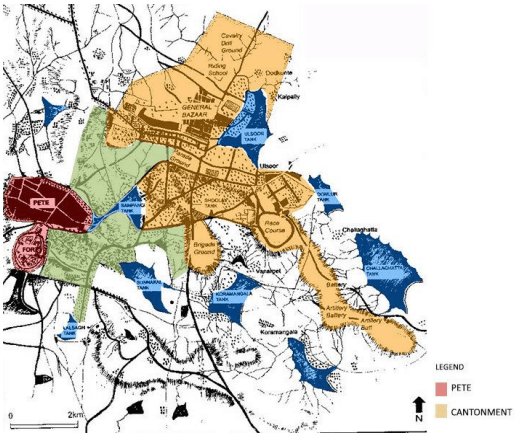
18th Century: marked the entry of the British. At that point of time there were 3 major distinct aspects of medieval life in the region: the grants to the Brahman Agraharas(residential areas), large temple complexes and construction of tanks. British developed Bangalore as a Cantonment around the Ulsoor tank in 1806 A.D. Creating the Cantonment on the high ground and the Pettap was located in
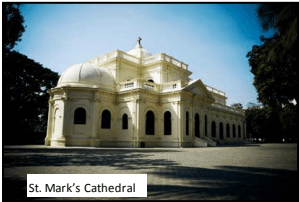
the valley showing their dominance over the natives. The British setup places for recreation like South Parade (MG Road), Brigade Road and Church Street and Parks like Cubbon Park and Coles Park, Markets like Russel Market. The Christian missionaries established churches and schools like Trinity church, St. Mark’s Cathedral etc. There was a clear divide in the city, one was The Pettah (Old City) and The Cantonment. Figure 14-2 shows a mapping of the Pete and the Cantonment in the 18th century clearly divided by green spaces like Cubbon park, Lal bagh etc.
19th Century: The 19th century saw the British further establish their rule over the region. The city was the first to be electrified in the country way back in 1905 AD. The important built form interventions in this period were mainly educational typologies like Indian Institute of Science, Agricultural school at Hebbal, Bishop Cotton’s School and the State Central Library. Also religious and cultural typologies like Hudson Memorial church, Daly Memorial Hall and Puttanachetty Town Hall came up during this time.
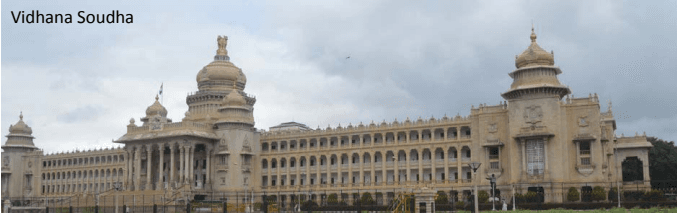
Post Independence the British had left a distinctive mark on the cities development. The Bangalore city corporation was established in 1945. On November 1, 1956, State of Karnataka was born out of the merging of the erstwhile Mysore state along with the Kannada speaking areas of Bombay and Madras states. Bengaluru was made the capital of the state and Vidhana Soudha was built as a seat of state legislature in Karnataka. Built in the Neo Dravidian/ Indo Sarcenic style of architecture by Kengal Hanumanthaiah, the Vidhan Soudha is an imposing architectural statement of the states aspirations.
HYDER ALI-TIPU SULTAN PERIOD
BANGALOE AUTHORITY ★
Figure 14-1: Chronological Heritage mapping
AUTHORITY ★
Note: The historical events have been compiled based on information from various published secondary sources and web resources. It was observed that in different sources there were variations in dates for some of the historical events. RMP 2031 has considered its best judgement while compiling the historical account as presented above.
Figure 14-2: Map showing Bangalore 1850, distinctly showing the Petta and the Cantonment
Source: Janaki Nair (2005), RMP 2031
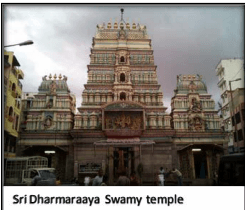
Architectural Style: Bangalore has a distinctive vernacular architectural styles spanning over 5 centuries. The earliest being the influence from the Western Ganga dynasty, who built the Nageshwara temple at Begur in 860 A.D. The temple has distinctive stone carvings, which follows anthropometrics and planning styles of Chola dynasty. The Vijanagara Empire under Kempe Gowda founded Bengaluru with the formation of the mud fort and also established various temples and
Sri Dharmaraaya Swamy temple
AUTHORITY ★
lakes. The earliest temples being Bull temple and Someshwara temple. At this point Mysore was established as the capital of the empire and Bengaluru was the commercial hub. Thus a lot of markets came up during this time. During the 17th century under Tipu Sultan’s reign, Bengaluru saw development in the form of rebuilding of the existing fort using stone. Also Mughal typologies like Mosques and Gardens were built, most notably the Lal Bagh gardens. Stone(Saddarahalli granite) being a local material was extensively used. This period saw buildings in the Indo-Islamic style, domes, arches and minarets was the basic character buildings had. The Tipu Sulthan’s summer palace is a classic example of this style of architecture. The palace is built completely out of teak with pillars, arches and balconies. The walls and arches are engraved with beautiful floral motifs.
Majority of the developments outside the Petta happened under the British rule. The British established Bengaluru as their Cantonment in 1806 A.D around the Halasuru tank. The British built
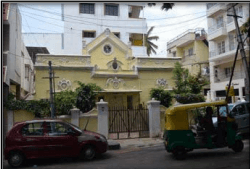
various parks, shopping centres, military infrastructure, churches, schools and bungalows. The bungalow typology was an influence of colonial architecture. It was a sign of control over the natives. The major architectural feature of the British bungalow was the monkey top. The monkey top was ideal for the Bangalore’s climate. Other building features include lancet arches, rose windows and Mangalore tiles (clay). The bungalows are majorly found in the Cantonment area, Basvangudi and also in Malleshwaram.
Colonial Bungalow on Kenchappa Road
14.2.2 Identification and Listing of Heritage Sites in Bengaluru.
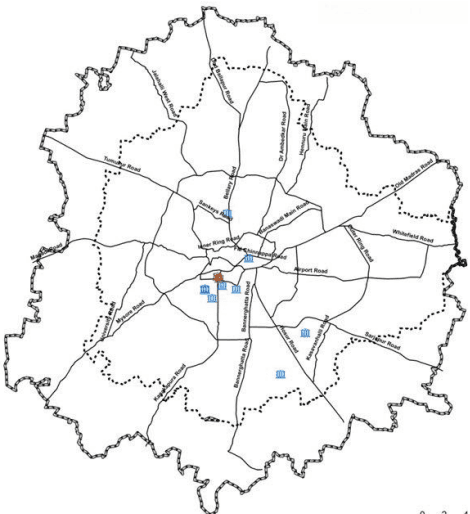
The city of Bengaluru currently has 9 protected heritage sites, of which 2 sites are Archaeological Survey of India (ASI) (centrally) protected and 7 heritage sites by the Department of Archaeology, Museums and Heritage (state) protected. Table 14-1 shows List of Protected Monuments in BMA and Figure 14-3 shows spatial mapping of Protected Heritage sites in BMA.
Table 14-1List of Protected Monuments in BMA
Sl.No
Archaeology Survey of India (Central Protected)
Department of Archaeology, Museums and Heritage, GoK (State Protected)
1.
Banaglore Old Dungeon Fort and Gate
Basavesvara Temple
2.
Tippu Sultan’s Summer Palace
Bowring Institute
3.
Gavi -Gangadhareswara Temple at Gavipuram
4.
4 no.s of Kempe Gowda's Watch Towers (Lal Bagh, Gavi puram, along Bellary Road)
5.
Mallikarjuna Temple and Boulder Inscription at
Basavanagudi
6.
Sri Nagareshwara Group of Temples at Begur
7.
Venkataramanaswami Temple at V.V. Puram
Source: ASI, GoI, and Department of Archaeology, Museums and Heritage, GoK
Figure 14-3: Protected Monuments in Bengaluru
This is against the listing of 747 heritage buildings prepared by INTACH for the erstwhile Bangalore Urban Arts Commission (BUAC) (constituted in 1983 and disbanded since 2002). This clearly indicated the urgent need for greater heritage awareness and sensitiveness amongst governing agencies and citizens alike. As mentioned above, city does not have inventory of its heritage assets. RMP 2031 has created the listing of heritage and cultural assets available in the Bengaluru.
The Revised Master Plan 2031 (RMP 2031) carried out the physical survey for identification of heritage sites and has documented the heritage sites based on various parameters like spatial location and extent, age of the building, building use, ownership, classification of heritage and their respective heritage value.
AUTHORITY ★
In all 558 sites have been listed, which include Heritage sites of Built, Natural and Cultural importance. 533 heritage sites are of built heritage value, while 16 heritage sites are of natural heritage value and 9 heritage sites of cultural heritage value It is noteworthy that majority of them are located within the core of the city.